


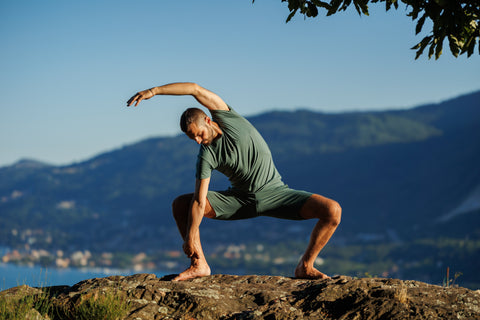

HIIT and yoga may look like two completely different worlds. HIIT is about pace, conditioning and explosive power. Yoga asks for control, focus and awareness of your breath. But together, they create a strong foundation for anyone who wants to get fitter and keep moving well.
HIIT helps you raise your heart rate, build strength and improve your conditioning in less time. Yoga brings mobility, body awareness and recovery back into the equation. The result is more complete training: you push when it serves you, and you know when it is time to ease off.
Not every session has to be all-out. The ability to move between intensity and recovery is what builds sustainable strength.
Why HIIT and yoga work so well together
HIIT is efficient, but it also asks a lot from your body. Your muscles work hard, your heart rate rises and your nervous system moves into a temporary high-alert state. There is nothing wrong with that, as long as recovery has a place in your routine too.
Yoga helps you move better under load. You develop mobility through your hips, shoulders and spine, while building control, stability and breathing awareness. Those are exactly the qualities that help you move with more strength and better form through squats, push-ups, lunges and planks.
When you combine HIIT and yoga, you train:
- Cardiovascular fitness and muscular endurance
- Strength, stability and coordination
- Mobility and quality of movement
- Focus under physical pressure
- Recovery after an intense workout
HIIT makes you fitter under pressure. Yoga helps you stay steady, strong and present when the work gets hard.
HIIT first, yoga after: a smart approach to recovery
For most men, this order works best: HIIT first, then yoga. Use the high-intensity section to work hard and finish with slower movement that lets your body settle again.
Yoga after HIIT is not a competition in flexibility. You do not need to force yourself into the deepest possible stretch. The aim is to recover, release unnecessary tension and allow your heart rate to come down gradually.
A solid structure looks like this:
- 15–20 minutes of HIIT
- 10–15 minutes of gentle yoga or mobility work
- 2–5 minutes of lying down or sitting quietly
After a HIIT workout, poses such as Child’s Pose, Low Lunge, Downward Dog, a reclined twist and Savasana are simple, effective choices.
Use yoga as a warm-up before HIIT
You can also use yoga before your HIIT session. Not as a long, slow practice, but as a dynamic warm-up that prepares your body to move.
This is especially useful if you spend much of the day at a desk, wake up feeling stiff or train early in the morning. A few minutes of intentional movement can change the way your squats, planks and push-ups feel.
Try a short flow with:
- Cat-Cow for the spine and shoulders
- Downward Dog to Plank
- Low lunges for the hips
- Slow squats with a tall spine
- Sun Salutations at an easy pace
Use the warm-up as an honest check-in too. Are your legs heavy? Is your lower back sensitive? Are you running on empty? Sometimes a strong yoga flow or a long walk is the better session for the day.
A 30-minute HIIT-yoga workout
This workout combines strength, cardio and mobility. Adjust the pace to your level. Good form always matters more than moving fast.
-
Dynamic yoga warm-up — 5 minutes Start with a few unhurried Sun Salutations.
Add Cat-Cow, low lunges and slow squats. Keep the movement fluid; there is no
need to go all-out from the first minute.
-
HIIT circuit for strength and conditioning — 15 minutes
Work for 40 seconds, then rest for 20 seconds. Complete three rounds of the circuit.
1. Squats or jump squats
2. Push-ups
3. Mountain climbers
4. High knees or powerful marching
5. Plank shoulder taps
Choose the variation you can perform with solid technique. A controlled push-up will always do more for you than a fast repetition with poor form.
-
Yoga cool-down after HIIT — 10 minutes
Finish with slower poses that create space through your hips, legs, chest and lower back:
1. Child’s Pose
2. Low Lunge
3. Reclined Bound Angle Pose
4. Reclined twist
5. Savasana
Stay with your breath in each pose. No rush. Nothing else to prove.
How to breathe during HIIT training
Your breathing does not need to look calm or perfect during HIIT. You are working at a higher intensity, so breathing faster is natural. The important thing is not to hold your breath unnecessarily, especially during push-ups, squats and other strength-based movements.
A useful rule: breathe out as you exert force. Exhale as you rise from a squat or press yourself up from a push-up.
During recovery and your cool-down, you can slow the breath down. Try inhaling for four counts and exhaling for six. A longer exhale can help your body transition out of high-alert mode.
How often should you combine HIIT and yoga?
For many people, one or two HIIT sessions a week is plenty — especially if you also lift, run, practise yoga or play another sport. More is not automatically better.
Yoga can be practised more often, depending on the style and intensity. A gentle mobility flow or Yin yoga can work well on a recovery day. A strong vinyasa practice naturally asks more from your body.
Pay attention to the signals you receive. Poor sleep, constantly heavy legs or low motivation are not weaknesses. They are often signs that recovery deserves more attention.
What to wear for a HIIT-yoga workout
For a HIIT-yoga workout, you need clothes that simply do their job. Training shorts or yoga workout pants that allow room for squats, lunges and stretches. A breathable tee or tank that stays comfortable once your heart rate rises.
Choose soft, natural materials that move with you and do not distract you. No fuss. No unnecessary details. Just comfort, freedom of movement and a fit that does not hold you back — on and off the mat.
Train hard. Recover with intention.
HIIT and yoga are not opposites. HIIT builds fitness, strength and mental resilience. Yoga keeps you mobile, focused and connected to what your body needs.
Together, they do more than make you fitter. They make your training more sustainable. Train with intention. Recover with awareness. Build a body that stays strong when it matters.